Showing posts with label Armistice Day. Show all posts

Sunday, 8 November 2009

Losing Count

Think not that I am come to send peace on earth: I came not to send peace, but a sword.
Holy Bible. St. Matthew 10:34

False Sphinx! false Sphinx! by reedy Styx old
Charon, leaning on his oar,
Waits for my coin. Go thou before, and leave
me to my crucifix,
Whose pallid burden, sick with pain, watches the
world with wearied eyes,
And weeps for every soul that dies, and weeps for
every soul in vain.
Oscar Wilde. The Sphinx


I'VE JUST RETURNED HOME after attending the Remembrance Day ceremony in Amble by the Sea. It was raining heavily early this morning, but had eased to a drizzle when I walked along to the Town Square. A considerable crowd seemed relieved when the sun broke through a few minutes before the two minutes silence and wreath-laying was to begin.

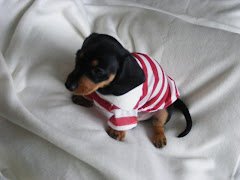
I didn't take Cailean with me, which turned out to be a wise move. We've had Guy Fawkes Day fireworks every night this past week and Cailean has been awfully upset by the flashes of light and explosions. At eleven, the clock in the tower in the Square did not sound, but a rocket was launched nearby and we all went very quiet. Two minutes later another rocket went up and the person leading the parade called for the Mayor to lay the first poppy wreath below the names carved into the memorial in the tower. I think Cailean would have barked.

During the First World War dachshunds in Britain were kicked, stoned and killed in the streets for being German. The Royal Family escaped that, a simple name change. Another dachshund story related by Robert K. Massie in the excellent book Dreadnought: During the Great War a member of the German High Command threw a party in his large country home. All the military leaders were invited; many came, though the Kaiser sent his regrets. Just as well, the host came down his grand staircase to greet the guests below dressed in a pink ballet dancer's tutu. His dachshunds were running rings around him. He stumbled, fell, and was quite dead (natural causes) by the time he reached the horrified crowd. Apparently it was not at all easy to get the plump corpse out of his tutu and into his military uniform so that things did not seem too peculiar when the body was to be collected.


During the brief silence this morning I did think of my grandfather's brother, James Arthur Lancaster, killed in the Pas de Calais on 2 September 1918. I also thought of my many close relatives who served in the armed forces (most in the Royal Navy) in the past 200 years and came home to their parents, wives, children, home to England. My cousin's son is an officer on a Royal Navy ship at this moment, and I thought of him out there in harm's way.

Noticing the young army cadets taking part in this morning's ceremony, I remembered being forcibly enrolled into our school Cadet Corps shortly before my fourteenth birthday. We had uniforms that were less comfortable than the ones the lads and lasses get to wear, as volunteers, these days. We had metal studs on our boots and when we stamped we made a great noise. Noise is good on parade, if not when you are marching towards your enemy. The parade today was dead quiet.

During the week there was a news story on the television showing British troops in Afghanistan preparing for Remembrance Day by erecting a very large wooden cross in their bleak desert encampment. It was a cross big enough to crucify a god on. And I was horrified!

I imagined Afghani folks, in their own country, coming by on foot, on horses, however they travel from village to village, and there's an enormous Christian cross on the skyline. I cannot imagine many Muslims all over the world seeing this on the television being too impressed to see that the spirit of the Crusades lives on.

We had Christian prayers in the Square in Amble today. I believe they were led by a Methodist preacher this year. We were remembering all our war dead (I suppose we are not to remember our dead enemies, even those who were Christians, at these times), but many non-Christians from the British Empire fought and died alongside those of us who might believe Christ walked on England's mountains green. Is it time to use a line from the play Sordid Lives: "Come down off that cross, buddy. We need the wood."?

There are a great many ghosts created on battlefields. At least seven of our boys died in Afghanistan this past week. One loses count.

Thursday, 13 November 2008

FOXHOLES

Queen Street & Mill, Harle Syke, 1910

Military Record for James Arthur Lancaster, 1918

Wancourt British Cemetery, France, 2008

War Memorial, Harle Syke, 2008

Queen Street Mill & Museum, Harle Syke, 2008


A certain scribe came, and said unto him, Master, I will follow thee whithersoever thou goest. And Jesus saith unto him, The foxes have holes, and the birds of the air have nests; but the Son of man hath not where to lay his head.
And another of his disciples said unto him, Lord, suffer me first to go and bury my father.
But Jesus said unto him, Follow me; and let the dead bury their dead.

St. Matthew, 8:19-22


My little dugout, my home these last two or three days: I am in a narrow trench about four feet deep, and my dugout is a hole scooped out of the trench side and roofed over with a piece of corrugated iron. When, at night, we settle to rest, and hang up oilsheets at the openings, and light our candle, we are quite comfortable, and happy.
Lance-Corporal Frank Earley, 1 September, 1918. (He was killed the next day, aged 19.)

I DID NOT KNOW of Lance-Corporal Frank Earley and his death in battle on the Western Front on 2 September, 1918 until I read the Imperial War Museum publication "1918 - Year of Victory" penned by Malcolm Brown. I was looking for information on my grandfather's older brother, James Arthur Lancaster, who was killed on 2 September, 1918, fighting alongside the Canadians as they smashed through the "Drocourt-Quéant Switch" offshoot of the Hindenburg Line.

There are only five sentences in the book about the battle for the Drocourt-Quéant Switch, and four of those are reflections on the use of names with Wagnerian connotations by the Germans for the lines in that area. They called the Switch "Wotan". I do not know how many hours the battle lasted, or exactly how many men died and what exactly killed them, or how much firepower was expended during the battle on either side. What was the ground like? Were there any trees left near Arras by 1918? Was it raining? Had the Tommies had time for breakfast? Were prayers held? Did anyone sing "God Save the King" (or even think it)? Did anyone try and run away? Did my mother's uncle die immediately, and was his body quickly removed to a morgue? Was he bagged or boxed? Was he missed?

I've never seen a photograph of James Arthur Lancaster as an adult. He was only 24 when he died fighting for his country, and, as he'd volunteered in 1915, I imagine he did care about his country. He'd been 21 when he signed on, and would have started working in the Queen Street Mill in Harle Syke, Lancashire, ten years before. Of course, that would only have been part-time when he was eleven years of age, he might have had another year with some schooling before becoming a full-time weaver. Perhaps, after ten years in the Mill, the King's Own Royal Lancaster Regiment, and the likelihood of some foreign travel, even under fire, appealed to the young man.

I have seen a photograph taken, I'd guess, in about 1905, picturing James Arthur Lancaster, then aged eleven, his sister Maud, who would have been about nine, and my grandfather, William Lancaster, four or five. The boys looked much alike, their hair cut to a stubble, dressed in identical outfits that may have been borrowed or hired for the occasion, as I doubt that the Lancaster children had much need for fine-cut, black, velvet suits with white, lacy shirts with enormously wide and high collars that seem purely decorative. Not even as useful as linen antimacassars, and the family would not have had those either. The boys looked a bit flash, to be honest. Maud had been dressed as I'd have expected a girl to have looked in her circumstances: plain. However, plain did mean many layers of unattractive cloth, set off by drooping ringlets. That sort of plain takes some work.

The Lancaster children had been posed amidst some grand furniture in front of a photographer's backdrop, a brocade curtain. And that is my picture of James Arthur Lancaster, the only one that might approach the real thing. He looks a good deal like his brother, so he may have grown up to look like my grandfather did, and I have seen photographs of my grandfather at the age that James Arthur was when he was killed in the Pas de Calais. James Arthur must surely have been taller than my grandfather to have been able to enlist, for my grandfather was only a very few inches over five foot. If like my grandfather, and my great-grandfather, he would have tended to be stocky, though I cannot imagine he managed to stay very plump in the trenches. His face would have been narrow, not a very good chin, and he would have been a bit bow-legged, small feet, but not unattractive.

James Arthur was sent to France in October of 1917. I don't suppose anyone in the family had crossed the English Channel in living memory. My father's people, the Eldridges, were sailors in the Royal Navy going back many generations, but my mother's relatives had been farmers and weavers and I have no record of even a distant cousin of some sort putting on a uniform. And we didn't have the money for holidays on the Continent.

I have a number of James Arthur's military records now. It is interesting to see his rather poor penmanship, as if he struggled when signing his name to his Attestation documents when pledging allegiance to His Majesty, King George V.
King George V had the family name Saxe-Coburg Gotha, he was the first cousin of Kaiser Wilhelm II of the Hohenzollern family. Lancaster was the name of an English Royal House, long before those Germans got involved.

One of the last of the papers that have come my way is shown above, and one can see James Arthur was "In the Field", which might have been fairly accurate. Or in a foxhole in the field. He was taken to a rest station a few times suffering from diarrhoea, and I imagine it must have been more severe than that one gets after a dodgy curry on a Friday night.

And, on 23 September, 1918, someone has made a memo on the records to show that the soldier was "Killed in Action". The memo was entered three weeks after James Arthur Lancaster died, and then the page seems to have been stamped and signed.

My great-grandparents, Harry and Elizabeth Lancaster, received word of their oldest son's death at their home in Harle Syke. Who answered the door? I wonder. It was just a few weeks before the War ended, my grandfather, turning 18, had been called up (fortunately, he contracted the influenza virus and was not caught up in the madness, he got to stay in the Queen Street Mill).

Another document, dated 4 May, 1919, has my great-grandfather signing for two medals awarded to his dead son. The War and Victory Medals. I have no idea where they might have gone.

The exact whereabouts of James Arthur Lancaster's grave was not known in my immediate family until five years ago when, through the Commonwealth War Graves Commission, I located him in the Wancourt British Cemetery in Northern France, not far from where he died. His grave reference is VIII H. 10. His name is on two memorials in Harle Syke, Lancashire, and I've shown the one by the town's bowling green. I wonder if he bowled.

The Queen Street Mill in Harle Syke is now a tourist attraction, a museum, boasting the only remaining steam-powered looms in the world. It has free parking, a gift shop and a café.

11 November, 2008, was commemorated as the 90th Anniversary of the Armistice that ended the War to End All Wars. Two Royal Marines were killed in Afghanistan today, squabbling with dusty people over some real estate that they want for their own people and we wouldn't know what to do with if we could take it from them successfully. So it goes.