Thursday, 18 March 2010

Murder'd Sleep


Now it's past my bed I know
And I'd really like to go.
Soon will be the break of day
Sitting here in Blue Jay Way.
Please don't be long, please don't you be very long,
Please don't be long, or I may be asleep.
George Harrison (Blue Jay Way)


I HAVE BEEN HAVING TROUBLE SLEEPING for about a month now. Not just being unable to sleep at bedtime, at night, but finding that I’m falling asleep when it is not convenient or appropriate.

I might be on a comfy sofa in a room with a number of my friends and associates, straining, admittedly, to connect with the conversation as I’m a tad deaf thanks to many years of very loud music (I have some roaring in my headphones at this moment, Tchaikovsky’s “Eugene Onegin” sung in English by Kiri Te Kanawa and Thomas Hampson, I cannot write in silence) and I am suddenly aware that my eyes have closed and if I take one slow, deep breath I’ll be fast asleep. And I worry I might start snoring. I quickly open my eyes. One of my mates is an expert on the sleep of others. “You were falling asleep, Ross.” And there’s no denying it. “I was. Didn’t get much sleep last night.”

I seem to sleep well enough one night, and then have a few nights reading until an hour before sunrise. At 5.00 I figure it’s not too early to get myself a mug of coffee: I make it with skimmed milk rather than water, and I use artificial sweeteners. Four minutes in the microwave. And back to bed, and the book. I switch on the radio as well, 6 Music, and deactivate the alarm. And, almost immediately, I fall asleep propped up as I am. Next thing I know, it’s after 7.00, the room is quite bright and Cailean is emerging from under the duvet. He needs to pee. My coffee, untouched, is cold in its mug next to my bed. It can be reheated, and is. The day is under way.

Another night I find I’m struggling to keep awake after the early evening news on the BBC. Lying on the sofa would be fatal, so I sit upright on it. There are, at times, programmes on the television that I do look forward to and enjoy. I’m missing some of them, even those that air before ten o’clock. I set the BT Vision Box to record anything that I definitely cannot miss, and it has a replay feature so that much of the programming on the major channels can be accessed for a week after it first airs. However, that means trying to catch up another night. I’m not much for watching television in the daytime.

I have a growing collection of DVDs. I buy them on the cheap usually, when there’s a sale. I also get them from second-hand dealers. And the DVD rental shop in Amble sells off its titles after a month or two, sooner if they’ve not been popular. I don’t like to spend more than £1.99 on a used DVD. One can get movies for £2.49 when the online outlets have specials on slow-moving stock. The great thing about DVDs is that I can watch a film for, say, an hour, and before I get too sleepy (as I tend to, no matter how exciting the story) I can note where I was, and switch it off. Another evening, I can pick up where I left off and, because I have a rather good memory, nothing goes missing.

I’ve not been to the cinema in over a year. Well over a year. I believe the last movie I saw was Martin Scorsese’s “Shine a Light”. The nearest Cineplex to Amble is about 35 miles away, and it’s not on an easy bus route, so I can only go with friends in a car.

I will tell you that I kept wide awake during Shine a Light which was, of course, a concert by the Rolling Stones. The theatre had an incredible sound system, we sat in the front row, and the volume was deafening (meaning, I could hear it). Other trips to the movies have had me struggling to keep awake. I stayed with “In Bruges” but slept through “Pirates of the Caribbean” even though the latter was a good deal noisier. Pirates, frankly, was rubbish. Loud rubbish.

When I can, I go to live concerts. It is almost impossible to doze off with a rock band in the hall. I fold away in the car on the way home. Live theatre, plays, can be dodgy. I’m always anxious that the actors will lose their way (a holdover from a few years involved with amateur theatrics) and don’t often relax. Should one be relaxed when the action is live, a few yards away, music or dramatics?

In another life I recall the first time I addressed the congregation in a particular church. There would have been about 400 people present. I noticed only those in a row of seats near the door at the back of the chapel, a dozen or so elderly High Priests. Before I’d even finished my introduction, the old men were slumping sideways, fast asleep. I can see why some preach Hell and Damnation with the speakers on high. My soft-spoken Peace and Love is Seconal for the soul.

I once fell asleep at a live concert in the Rosebank Theatre in Bermuda. It was a fundraiser, a number of acts and rather haphazardly arranged. A little of Handel’s choral music, then a calypso. Some tap-dancing. That bloody “Summertime” by a mezzo-soprano. Sleep was a welcome escape.

One evening, forty-mumble years ago, I went to dinner with friends at the Royal Bermuda Yacht Club. The RBYC was hardly my usual eatery. This was the sort of meal that started with drinks on the terrace, and then there was wine with the meal. More drinks to follow, and a couple of Valium. This particular dinner is memorable because afterwards we went to the Island Theatre (an oddly charming, if awfully run-down place) to see Laurence Olivier’s film version of “Othello”. This was a charitable airing of the film. I cannot imagine Bermuda providing more than one show’s audience, and that in a very small cinema. I’m not even sure that a play with a white man in blackface was entirely acceptable. (I recall being absolutely horrified to see “Black and White Minstrels” on stage in Morecambe as a child ten years earlier.)

We sat in the back row, upstairs, of the Island Theatre, in the corner. The Island Theatre had tattered, uncomfortable seats. I can still relive the feeling. One was allowed to smoke in the movie theatres then (just about anywhere but church, actually, and I’d have gone to church more often if I’d been able to light up during the Family Communion Service), but I was with people who would have frowned on that. I recall the opening titles, and feeling fuzzy in my Bacardi and Valium haze. And that was “Othello” for me. I slept soundly through the next (almost) three hours. Thank God!

Jumping ahead 25 years, I saw “Phantom of the Opera” staged in Los Angeles in June 1993 at a very large and well-appointed theatre, but from the cheapest seats. Call it “The Gods” if you will, but these Gods were totally out of touch with the world far, far below. I could not make out the words, dialogue or the lyrics of the songs. I had no opera glasses, I have rubbish eyesight, and I could not tell one over-dressed character from the other. What to do? I tried to clamp my eyes shut and get away from it. Could I sleep? No! I was trapped, awake, for a couple of hours. Happens that after the performance I was taken around to the stage door to meet the actor, Davis Gaines, who played the Phantom. Mr Gaines was very pleasant, posed for a photograph with us, and asked how we’d enjoyed the show. “Brilliant!” was my reply. “Loved it!” Though, to be honest, I hadn’t been able to make any sense of it. (I’ve seen the movie version on DVD and still don’t know what the heck is going on. I really don’t like the play except for the one song “Music of the Night”.) Phantom may have bored me silly, but Davis Gaines took the lead 2,000 times, playing to five million people. He must have liked it well enough. I wonder if he slept soundly when he got home after the show.


It happens that in 1977 the future Grammy award-winning musical director of Phantom of the Opera (and many other musicals on stage and film ), David Caddick, spent his Easter vacation at my home in Bermuda with his partner. David should know that I quite liked the film "Evita", which he produced, and that I stayed awake all the way through it.

Last night I slept well. I switched the light off around midnight and next thing I knew the telephone was ringing. I’d not set the alarm, a friend was outside. I did my best to sound wide awake, as if I’d been up for hours. It was 8.15. I’m feeling well-rested today. Well enough to catch up on my correspondence seeing as I’m not out in search of a pub lunch with some friends. I was going to read, but I’m so enjoying the music of the day, in my headphones, I believe I will trip out on that. Eugene Onegin is far, far better than Phantom.

Will I sleep tonight? The pattern is too unpredictable. In a week, I seem to catch up on missed sleep. Chances are I’ll be wide-eyed. Well, unless there’s something I really, really don’t want to miss.

I will go through the motions. Hot water bottle, pillows plumped, Cailean lifted onto the bed (he’ll vanish under the duvet for his 8 hours). But, also, a book or two, my reading specs, and the radio at hand. The musing of the night.

Sunday, 14 March 2010

Shamrock and Roll

Well if you ever plan to motor west
Just take my way that's the highway that's the best
Get your kicks on Route 66
Well it winds from Chicago to L.A.
More than 2000 miles all the way
Get your kicks on Route 66

Bobby Troup (Route 66)


TODAY IS MOTHERING SUNDAY in the United Kingdom. This afternoon there were some lovely bunches of flowers for sale outside the two shops that normally have them in Amble, and a few unopened daffodils in jars outside the hardware store. Now it seems to me that mothers probably would have appreciated any floral arrangements first thing this morning, perhaps even last night. The shops were not doing any business.

When Cailean and I walked to the open-air market (every Sunday on the Amble docks) not only our main shopping street was quiet, but there were few stalls and shoppers on the docks (despite glorious weather). A week ago every man and his dog was there. Among the few stalls was the wagon that sells hotdogs. This wagon has flying over it a large American flag. I did try one of their hotdogs once, and it was watery, salty, and vile. No amount of condiments could save the thing. We don’t even do sauces and relishes well here. Hotdogs are often offered with soft, slippery fried bits of onion. Frankly, they are best avoided.

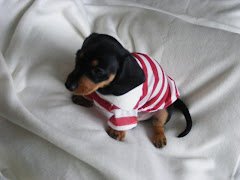
On the way home we bumped into one of Cailean’s dog friends, Humphrey, who is also a black-and-tan miniature dachshund. He’s a bit smaller than Cailean, more-mini. Lovely little fellow. And today, to our surprise and delight, we met Humphrey’s younger brother, only five months old (Humphrey, from an earlier litter, is Cailean’s age, two). The new wiener in town is called Bo, short for Bogart, and he’s a black-and-silver dapple. When three miniature dachshunds get together for a scratch-and-sniff, it’s a bit like a family of otters on a riverbank.

Passing the florists' shops again I noticed that no flowers had been sold. I was tempted to buy some, but they were awfully expensive. I might get a leftover bunch tomorrow for a fraction of the price.

We had St David’s Day on 1 March. The Welsh flag was flying in Amble’s Town Square (no sign of the Union Flag that day, or the bloody EU banner) for the day. There were a few forced daffodils on sale, and we’ve always got leeks to spare. The saintly David was actually Welsh, born in about the year 500 AD.

St George’s Day is on 23 April. He’s the patron saint of England, noted for slaying a dragon. I tend to confuse St George with St Michael because there’s a wonderful sculpture by Jacob Epstein of St Michael overcoming Satan on the outside of Coventry Cathedral. England’s patron saint, George, was not English. He was born in Palestine in roughly 275 AD. Happens George is the patron saint of a fair number of countries including Ethiopia, Greece and Russia. And Georgia. 23 April is said to be the day, in 1564, that Shakespeare was born. Actually, nobody knows that for sure, but he was baptised on 26 April that year. He died on 23 April 1616, which may have been his fifty-second birthday.

The Scottish patron saint is Andrew. Now he was, apparently, the brother of Simon Peter, and like him one of the Apostles associated with Jesus. I’m guessing he was born in the Middle East in about the year zero. 30 November is St Andrew’s feast day, and the national day of the Scots.

The Irish celebrate St Patrick’s Day. He was not Irish, but was born over the Pennines from where I live in Cumbria. He was a Roman-Briton and may have been born in 387 AD. His feast day, the national day of the Irish the world over, is 17 March. On that day the beer turns green, as if by magic, and one might see someone wearing the traditional headdress with the words "Kiss Me I’m Irish" written across it.

Now, I have no idea whether our florists will have shamrocks for sale. I don’t know if many Irish folks live around here now that there’s no industry. We do have Irish Travellers (you’ve heard them rudely called “Pikeys” or “Knackers”) that pause in this part of the northeast, and they are generally not welcomed with open arms. Will the pubs in town have green beer? I’ll look for signs of this. Now that one must smoke outside of any public building, glasses and mugs are often left on the pavement outside the Waterloo, the Dock, Pier 81, and so on. There may be a green residue in those. Perhaps green vomit in the gutters.

In late October of 1979 I was the designated passenger (and map-reader in those days before the SAT-NAV) as a friend drove us across North America from east to west. We were following the old Route 66 once we moved inland from the Carolinas. My friend had one of those enormous gas-guzzling Fords, eleven years old, and it was heaped with things we thought we’d need for a winter in the Rocky Mountains. That included, for the journey, a pup-tent.

We used the tent for the first time just outside Oklahoma City, setting it up in a grassy field that seemed to be owned by the KOA. It was dark when we walked into the field and got the tent up. We’d had a meal at a roadside cafe called The Picket Fence. It had a jukebox and I put in a quarter and we listened to the Rolling Stones’ song “Miss You” ... Not one of their best, but it was played in the discos, and a cafe in Oklahoma.

When I woke in the morning, I pushed open the flap of the tent and saw, close up, a spider doing the arachnid equivalent. A trap-door spider. And then, to my horror, I realised that we were sharing the field with a herd of cows. This would not be a KOA! No wonder there had been no office, no toilets, and no showers.

We hustled ourselves out of the field, closing the gate behind us.
On the Interstate we made good time heading west until we reached the Texas Panhandle. Suddenly, as we came over a rise in the highway, the car’s bonnet started steaming, then billowing, and the car began to lurch about. My friend got it onto the shoulder of the road where the engine gave up completely. We pried the bonnet open and boiling liquids sprayed about.

I’m sure we were cussing, but I don’t recall. I would have been panicking, I reckon. There was, however, a sign by the highway indicating a service station not far ahead. My friend set off in that direction on foot, and I quivered with fright in the car. At least it was a sunny afternoon.

My friend returned in a tow-truck sort of vehicle driven by someone from the garage up ahead. The mechanic hitched up the dead Ford and we all drove into the nearest town. It turned out to be Shamrock, Texas.

Shamrock, Texas, in 1979, looked a bit like the end of the Earth to me. I’d been accustomed to beaches in Bermuda, not dust and tumbleweeds and wooden, raised sidewalks. There were a fair number of boarded-up store-fronts; everything needed a lick of paint. The mechanic said he’d look at the car, and we went looking for a Coca-Cola. When we returned to the garage the mechanic said things looked pretty bad: The Ford’s radiator had completely disintegrated. What’s more, that model and year the radiators had been peculiar. It would not be possible to get hold of a new radiator to fit the eleven-years-old car. We were buggered.

At that moment, I said something odd and, at that time, not unexpected. I told my friend that if he quit smoking then and there (something I’d done recently, so I was insufferable on that subject) everything would work out. My friend agreed, though not happily, and we wandered around Shamrock waiting for the miracle. An hour later, back at the garage, our mechanic was smiling. He’d been to the town’s dump and had actually found a 1968 Ford, our model. He’d been able to cut the radiator out of it.

I think we paid about $100 for our afternoon in Shamrock, Texas, which was a fair bit in 1979. I’d asked what exactly the people in Shamrock did, with it being little more than a service station. The oddest thing, it turned out.

Every March the Shamrock Post Office receives many, many cards and letters to be posted on from there with the Shamrock cancellation mark on the envelope. Cards and letters celebrating St Patrick’s Day, going all over the world.

It was late October, as I mentioned, and the town was quiet and dusty as we drove back to the Interstate.

We pushed on to Santa Fe, New Mexico, and then into Colorado, sleeping that night in a genuine KOA near Durango. Durango was (and is) a resort town, quite upscale in an historic way. The scenery is exquisite with rivers and waterfalls and mountains. It seemed very much like the Promised Land after the Texas Panhandle. We should have stayed there. But that’s another story.

Every St Patrick’s Day I think of shamrocks, and 1968 Fords in Texas. Season of the Hitch.

Monday, 8 March 2010

Don't Ask. Don't Tell.


I’m a Jew.
I’m small.
I’m homosexual.
I live in Sheffield.
I’m fucked.

Alan Bennett (The History Boys)


LAST WEEK I HAD A TELEPHONE CALL from a young woman. Hardly necessary to mention that the call came in the evening when I was busy having my tea and watching Coronation Street.

“Hello. Is this Christopher Eldridge?”

“This is he.” (I am named for my great-great-great-great-grandfather, Christopher Eldridge, born in Leicestershire on 27 July 1777. However, I normally use my middle name, Ross.)

“I’m calling on behalf of the Liberal-Democrats.” She does not even take a breath. “What we’d like to know tonight is how you intend to vote at the upcoming General Election.” (One must be held before the end of June, likely date is 6 May.)

There followed a pause on my part.

“Mr Eldridge? Which party will you be supporting?”

“I believe,” I told the young woman, “that one’s vote is a private matter. It happens at the ballot box on Polling Day.”

“Oh,” she said, followed by a long pause. I imagine she was looking at her guidelines. “We just want to know who you will be voting for, Mr Eldridge.”

I said that I’d prefer not to tell her and as she was about to say something I put the telephone handset down.

I might have reminded her that William Gladstone, the Liberal [sic] Prime Minister, steered the bill that became the Ballot Act of 1872 through Parliament. Prior to that time voters had to mount a platform and publicly voice their choice of candidates to a recorder who would note it in his polling book.

Obviously that left the recently enfranchised working class (the Reform Act of 1867 had given some 1,500,000 men the vote, doubling the electorate) open to pressure from the employers who could, and would, listen in as votes were cast. I recall all this from my history lessons forty-mumble years ago.

The woman from the Liberal-Democrats on the telephone had my name, my 'phone number and probably my address. She might have known my age. This was not an anonymous opinion poll.

I offer this experience as a word of advice to my readers. One does not have to share one’s choice of party or candidates with family, friends, employers, one’s church, or with political parties. If the Secret Police turn up at my door, I am not compelled to tell them who I will be voting for in a few months’ time. (In North Korea the rules would be different, and perhaps in corrupt democracies propped up by Britain and the USA, like Afghanistan, as well).

I have been voting in general and other elections for about forty years. I have never joined a political party, and I have voted for both right-leaning and left-leaning candidates, but based on the issues and not ideology. When the candidates have been present outside the polling station, I have offered a firm handshake to all and sundry with no nods and winks. I say I’ve never joined a political party and I should clarify that. I once sent a £10 donation to a party to help fund a project that I believe in. But I carry no membership cards.

I once helped a friend sort through a box of index cards on which was gathered information on all the voters in a political district in Bermuda. The cards were compiled by one of the two major parties then operating in Bermuda. The prospective voters were not contacted and asked for their choice of candidates. The names on the cards came off the electoral roll, and then a committee tried to figure out which party the voter might support based on his or her address, surname, and any information that might be gleaned from other sources. One thing noted on the cards was the voter’s race. This was not written down as black or white (the two parties being different mainly by racial make-up). Some reviewer simply made a mark with a coloured pen on cards of voters who were thought to be non-white. As I recall, my friend was updating the cards. Perhaps a voter had moved to a more upscale address and might be judged more conservative. New voters would be added and dead and departed people would be pulled from the box.

In Bermuda one was always for one party and, logically, against the other. It is a bit like that in the USA, I gather. In Bermuda one does not take fire at (or make jokes about) both parties and leaders, one takes sides. Comedy and commentary is one-sided.

In Britain we tend to have a go at everyone, regardless of political identity. Thatcher and Blair are remembered and hated equally. ("What the hell were we thinking?") We all seem to feel no love for Gordon Brown (Labour), David Cameron (Conservative) and Nick Clegg (Liberal-Democrat). After the expenses scandals we dislike and distrust all the elected MPs and the appointed Lords.

We are a country at war in Afghanistan, and one worries that politicians resort to war when they are having a hard time on the home front. The Second Falklands War might be inevitable with the Brits and the Argentines wanting diversions from economic crises. The candidates from our three major parties are not promising us war or peace, advance or withdrawal. We are getting no firm policies promised, things change on a whim. There is no candidate who will say what he really stands for; he’s too busy shuffling his feet over revelations in the press.

Unlike the United States, we do not have Oprah Winfrey or Pat Robertson to tell us who to vote for. Oprah imposes her will by throwing a party for her party and injecting a degree of hysteria into a campaign. Robertson’s God stares out through the broadcaster’s eyes and dares White Christian America to defy Him. The parties are basically Gay and Straight.

Britain is essentially a non-Christian country if votes are tallied. The BNP (British National Party) which is far-far right, and seeks to keep Britain British ethnically and racially and culturally, is probably the closest we come to a Christian party. There is, somehow, something of Pat Robertson in the BNP’s Nick Griffin, though Pat Robertson is probably less likely to approve of cross-burning, and Jew-baiting, and the eradication of deviant homosexuals and democrats.

What is outstanding is that one might be a Gordon Brown Labourite, a Liberal-Democrat supporter, High Tory, or a friend of the BNP. One might intend voting for the United Kingdom Independence Party (UKIP) to get Britain out of the EU. One might be voting Green. There was a Party of Jesus Christ in the last election. We even have The Monster Raving Loony Party if you fancy wearing a funny hat. We don’t seem to go for dyed-in-the-wool blue or red here.

The important thing is, thanks to William Gladstone, we have the secret ballot. We have the ability to vote our consciences. No political party worker has the right to quiz us and to mark boxes alongside our names. No man can threaten us unless we actually choose to take up a banner and march in the street. To decline to vote is to refuse an important right: The right to be part of society. No one candidate will meet all your needs, but an unselfish look at the issues and vote on what is best for the most might be satisfying.

Vote! You need the exercise!

Tuesday, 2 March 2010

Ton-Up


"If the doors of perception were cleansed
every thing would appear to man as it is, infinite.
For man has closed himself up,
till he sees all things through narrow chinks of his cavern."
William Blake (The Marriage of Heaven and Hell)


ON 14 AUGUST 2008 I made my first entry on this Barking Mad Blog. It was my “Arrival” and “A Bit Late” but “Well-Dressed” and featured a picture of Cailean sleeping in his bed under my desk. He’d have been less than six months old. He has that same bed today, still under my desk. Yes, I do wash it every week or ten days. Cailean will be two years old in a few days’ time.

This is entry 100 on this Blog. Clearly I have produced more than one a week averaged over the last year-and-a-half. I’m surprised. Pleasantly, I think.

Forty-mumble years ago when I was at Warwick Academy, I guess I’d write a composition for my English Language classes (Frank “Buck” Rogers taught that class, and our subjects were taken from former GCE Examination papers) once a fortnight, perhaps less frequently. I only recall two subjects: “Lawnmowers” and “A Day in the Life of My Town”. Ugh! I wrote longer essays in History classes: “The Glorious Revolution” and “Lord North and the American War of Independence”. Ugh! Still longer essays in Biology: “A Field Trip in Paget Marsh” and “The Rise of Coelenterates”. Ugh!

We spent a good deal of time writing (using fountain pens, not Biros or pencils). We did not have multiple-choice questions in any GCE subject at any time. The only occasion requiring a choice and a box inked in was for a Scholastic Aptitude Test that was supposed to be interpreted by professionals at the Department of Education who would then tell us what careers we might be best suited for. They had me down as an architect. I had abysmal results on the Spatial Relations portion of the Test. Go figure. Ugh!

Our mathematics master, Eustace Pierce Roberts, a young, red-bearded Welshman from Denbigh with a blue MGB-GT sports car, divided punishments into two types. “Undone homework” resulted in Detention after school, during which time one would have to do the homework. “Misbehavior in Class” was rewarded by having an essay set, to be turned in the next day. “Iggy” Roberts, as we called him, would, I think, give an essay title on the spur of the moment. Usually very brief subjects like “Snow” or, after the entire class dropped rulers at a signal, “Falling Lumber”. We had wooden rulers, marked in inches, none of that metric nonsense.

I tended to do my homework, I was quite good at grammar school mathematics, and I was never put in Detention for having failed to turn in assignments. I rarely acted up in class with the others, and was pretty much a model student (my handwriting could have been neater). I believe I had to write on “Falling Lumber”. I was glad to. I enjoyed Iggy’s essay subjects and would, from time to time, write essays for my friends to hand in when they were being punished.

Once a term, for a few years as my grammar school career wound down, I would write a fair bit of the school newspaper, Quid Novi. I was its Editor. I was the anonymous poet (credited under my real name by “Anon”) and I would write up short articles, usually arising from quizzes the youngest children in the Junior School responded to. One could get a fair bit of mileage from questions like: “What does the Headmaster really do?” and “What is the worst school rule?” (We once determined that the school’s official rule book had over fifty listed, the Bible having only Ten Commandments.)

My school Leaving Certificate, which was posted to me in England because I went sailing (for the one and only time in my life) during our Graduation Ceremony, mentioned my efforts as Editor of the School Newspaper, and that I was Head Librarian, and that I was in the School Cadet Corps. Two out of three weren’t bad.

I had no essays to write at The Medway & Maidstone College of Technology, but I did attempt to learn something that might confirm my latent talent as an architect. I passed my advanced mathematics and physics courses, as well as Engineering Drawing. I hated it all.

Aside from business and personal correspondence, I wrote nothing original for over thirty years. Then I had this mad idea to write essays again, on subjects that came to mind. I tended to look back thirty years, to times before my pen had gone silent. When George Harrison died in late November 2001 I wrote something I called “What George Harrison Meant to me”. He’d been my favourite Beatle. I sent the essay to the newspaper and they published it. For several years I wrote, weekly, something that seemed interesting, and often the newspaper was interested. Not much money in it, but I enjoyed the writing experience. I moved on to reviewing art shows and theatre when the newspaper’s critic died. I certainly was no artist myself, or actor, but I’d painted at one time and had helped produce local theatrical efforts. I knew what I liked and could blather a bit about it.

Why do I write? I am a constant reader, in fact I usually have three or four books going, and pick up the one I’m most in the mood to read at any time. I can only think that all the reading feeds the writing. As I read, I make notes. I have scratch pads around the flat, and in my coat pocket, and things go down on the pages.

I tend to write for an hour-and-a-half, and that gives me about 1,000 words. Any longer and there is an effort required. Frankly, I find 1,000 words more than enough to read in one go, and when I’m finished I feel I need to read what I’ve written. Then it’s gone, I let go of it. There are 99 Barking Mad Blog entries, and now this one, that I shall probably never read again. Totting up the hours I must have spent writing these entries, it’s a month’s work stretched over a year-and-a-half. 100,000 words, a thin novel.

I’ve recently discovered Twitter, and I’m really enjoying writing in a box that permits 140 characters, or less. I do not use cute abbreviations, I insert appropriate punctuation, and I go with English, so usually longer, spelling.

Some five or six years ago I was hired on as a night school “teacher” for classes in Creative Writing. I’m not a teacher, of course, and it was more of a coaching position. We had very brief assignments to turn in the next week; most of the class time was spent in discussing writers and writing, and reading. I wanted to turn the people on, not off.

Using the correct faculties, one can “see” the world in a special way. Things at the far end of a telescope are brought within reach. There is light enough. One can hear the words being spoken. Then it’s just a case of scribbling them down on what is at hand. Keyboards fix the handwriting.

John Lennon: “There’s nothing you can do but you can learn how to be you in time. It’s easy.”

George Harrison: “See all without looking. Do all without doing.”

One hundred on the page. The ton-up. And now I’m going out into the light.


Friday, 26 February 2010

Stormy Weather

I was born in a cross-fire hurricane
And I howled at my ma in the driving rain,
But it's all right now, in fact, it's a gas!
But it's all right. I'm Jumpin’ Jack Flash,
It's a Gas! Gas! Gas!

The Rolling Stones (Jumpin’ Jack Flash)


AS IT HAPPENED, I WAS NOT born in a hurricane. It must have been a pretty fair Sunday morning because the doctor who delivered me (feet first) was planning on going sailing that day in November, mumble years ago. I arrived at 7.06 a.m. and I’d like to think the doctor managed to head over to the Royal Bermuda Yacht Club. I don’t know how many hours he had spent dragging me into this world. He might have been tired.

Yesterday, in Northumberland at least, the rains came. The last bits of snow and ice on my courtyard finally washed away. I spent the morning down the coast in Blyth, or in a field outside Blythe to be accurate, standing in the steady rain and a freezing fog, looking at polytunnels. Only a couple of the tunnels were in use, and they were not very warm inside, despite having some heated air pumped in from time to time. Tomato seedlings in one, and sprigs of lavender and bits of geraniums in rows and rows of plastic pots in another. I noticed an almost-dead rubber tree, five feet tall, in a large pot. I imagine it had lost its will to live over the harsh winter we’ve had.

I am familiar with rubber trees. Full-grown, enormous rubber trees in Bermuda. I have climbed about in them, including one that was famously painted by the artist Georgia O’Keeffe in the mid-1930s when she was recovering from a nervous breakdown. There was a rubber tree near my mother’s home, and we’d swing on ropes in it. Outside the Bermuda Library in Par-la-Ville Gardens, another rubber tree giant loomed over the verandas where I’d sit and read in the warmer weather. Rubber trees like to be warm and moist.

Last night I stepped outside in the rain and took a picture of my flat. That’s the photograph above. To be honest, we don’t have a great deal of heavy rain up here. This winter has been unusual for abundant snow. In four years it has not seemed worth taking a look at the rain, much less getting the camera out in it. Four years ago the reservoirs were running dry and we were not to water our lawns or wash our cars. This year I’m taking long showers and deep, hot baths, and I’m not feeling any guilt.

In Bermuda, despite a wet climate, the rain was not dependable. We might have three months of more-than-average rainfall, then many months of severe drought. Our water was caught on our whitewashed rooftops, running into tanks below the ground floor. We were permitted brief showers and very shallow baths. I still have a moment of panic and guilt to work through if I’ve been showering more than 90 seconds.

Curiously, I don’t recall many rainy days in Bermuda, though we must have had a few. I walked to and from school, or had a bicycle, and I can only think some days must have been inclement. I don’t recall having a raincoat or umbrella, which would have been a bother at school. We had a few rainy lunchtimes at school. Normally we ate picnic-style comestibles out on the fields. When it rained we were crammed into the school’s lunchroom. This room was also used if we were to see a film (the only film I recall involved a dam across the Zambezi River). In the lunchroom we had benches without backs and fold-away tables. The lunchroom eventually became the biology lab, same benches and tables. I cannot think where we spent rainy lunch periods after that conversion. Rain must have been rare, or a feature of the night.

During school holidays, I do remember a very few days spent on our dock, sheltered beneath an overturned boat on the planks, with fishing lines lowered through the gaps. I think we took shelter because someone usually had a precious transistor radio. But holidays were not rained out.

In Bermuda, it always rained on either Christmas Day or Boxing Day. We did not suffer this in misery, and we usually went visiting by car (relatives or taxis).

In England, rain rarely interrupted my life. I do remember standing in Piccadilly Circus very late at night in a downpour and discovering that the reflections in the water running around our feet were as exciting as the lights blinking on the buildings around us. An out-of-sight light show. Holidaying with my mother’s people in Harle Syke, Lancashire involved cold summers; we’d have coal fires in August, but misty rain at the worst. And if off to Morecambe for a week or two, every day we’d been walking along the front, or on the sands. Hardly hiding away from downpours.

I remember three hurricanes in Bermuda. Arlene, in August 1963, flattened all our tall casuarinas. The root systems were so dramatic when ripped from the ground that the local newspaper sent a reporter and photographer round to our house. My sister and I made the front page.

Hurricane Emily came along in late September of 1987. We woke to find it on top of the Island. It moved on quickly, but did a good deal of damage. We had no electricity for ten days. Fortunately, a neighbour had a cooker that used gas in cylinders and I was able to cook all my food. Water had to be dipped out of our tank with a bucket on a rope, enough to wash one’s face and underarms and bits, and to flush the toilet once or twice a day. The trees we’d planted to replace the casuarinas lost in the 1963 storm all came down in 1987.

On 5 September 2003, Hurricane Fabian roared over Bermuda and paused there for the best part of 15 hours. I was not quite alone in my cottage, my dog Aleks rode out the storm with me. The electricity went off almost immediately, and the reason was clear. From the house I could see that every tree in every direction had come down, and any power lines (and other utilities carried on poles on the roadsides) were in a tangle of trees in streets, on lawns and slumped across rooftops. I’d heard a thump, and the ceiling in my living room started leaking, but it didn’t collapse at least. Remarkably, my telephone kept working and through the day and late into the night I was able to speak with friends. One described his roof tiles dropping around his home, miraculously missing his car.

Fabian left me without electricity for a few days, but because I lived across the road from Bermuda’s Deputy Governor, and a few doors down from the Premier, the streets outside my residence were cleared promptly, and cables were going up on new poles within a day or two.

If you want to experience driving rain, a hurricane on an island 600 miles out in the Atlantic is the way to go. The rain comes at you horizontally; the waves break on the edge of the volcanic archipelago and sweep over everything. Tornados and water spouts drop water from overhead.

In Hurricane, Utah, about 15 years ago, I experienced a flash flood. I was with a friend in her car, not a mile from her home, and suddenly we were inundated by water. First from above, onto the hard desert sand and rock. The rain could not soak into the ground and Hurricane’s streets were soon awash as water roared along the valley floor. Cars were being driven up onto anything higher than street level, we followed. And for a relatively short time, perhaps 15 minutes, we watched the new river running through town. And then it was gone, rain and river. The sun blazed through and in an hour dust and tumbleweeds blew down Main Street as usual.

It is raining heavily today in Amble by the Sea. Cailean has refused to go more than a squat outside the door. I have the day off, and I had things I needed to do in town. So, off for a haircut and postage stamps. The barber and the postmistress both wondered why Cailean was not with me. I explained that he was not overly fond of chilly rain. If there’s running water on the pavement, or puddles, Cailean ends up swimming with those very short legs.

I’m enjoying the rain beating on the windows. I'm writing and listening to Tchaikovsky's Eugene Onegin, sung in English. Cailean is in his bed, under his blanket. It’s not all bad, this rainy day.

I can show you
that when it starts to rain
everything’s the same.
I can show you.
I can show you.
Rain, I don’t mind.

The Beatles (Rain)

Wednesday, 24 February 2010

Ode: To Peace in a Podcast

You can’t teach an old dogma new tricks.
Dorothy Parker


I USUALLY TURN TO SHAKESPEARE for an opening quotation. I’m writing about Cailean’s second birthday, and I may have other canine pet stories, so I searched for a line or two featuring the word dog. My first search gave me almost 200, and not one was complimentary to dogs. Nearly all were put-downs of men, comparing them, unfavourably, to dogs.

Perhaps Shakespeare had bad experiences with dogs. Barking during performances at The Globe, fouling the pavement outside his lodging house. Might he have been bitten? Did a puppy chew a favourite quill? And it may be that dogs were mostly street creatures (completely wild or bear-baiters), except for those at Court (and those bred to hunt). One routinely sees lap-dogs in paintings only after Shakespeare’s time, I believe.

If not Shakespeare, then who might give me a good line? William Blake’s “A dog starved at his master’s gate / Predicts the ruin of the state” came to mind. Clearly Blake had a higher opinion as to the worth of a dog. Good man!

And I recalled photographs of Dorothy Parker with her black, standard dachshunds. Ms Parker lived in hotels most of her adult life and her rooms, apparently, were rather filthy thanks to her pets and her reluctance to walk them, and clean up after them promptly. Dorothy Parker is usually a quotation mine, but the only one I could find (above) is about dogma rather than dogs.

A dogma is, briefly, a belief, a principle or an opinion, or all of those. We tend to associate dogmas with religion, and religion with peace and love. Religious dogma, to my mind, has been antithetical to peace and love. I took history courses at my grammar school, and I watch the television news.

A dog is, briefly, what you make him. I suppose one could train a dog to act on one’s dogma, but you could not train a dog to seek out, say, Muslims, by any means except the outward observances of their belief. Clothes, perhaps. I thought of Muslims because many of them find dogs unclean somehow, that's part of their dogma. Give any man a stick and a dog will be nervous, give a man a smile and a dog will likely wag his tail.

Today is 24 February 2010. It is very nearly my Cailean’s second birthday. He’ll be a two-years-old on 8 March. If that seven human years for one dog year holds, he’s a teenager.

This Barking Mad in Amble by the Sea Blog is nearly always written with Cailean next to me. Sometimes he will put a paw on my foot, and I’ll find he’s looking up at me. When the blogging takes a long while, there may be a toilet break required. Cailean always asks to go outside, something all my other dogs did not always do. You are going to meet them.

Happens that I have a fairly good memory and recall that when I was a boy we had an American cocker spaniel, a pretty, pale-gold, spayed female that we called Shammy (being short for Champagne, her colouring). I actually remember that Shammy was born on 24 February 1960. That’s 50 years ago exactly today. I didn’t see the new-born, but chose her from the litter about two months later. My father took me, which is interesting in that he didn’t live with us, and we rarely saw him or heard from him. I suppose he paid for the puppy. He did name it. We celebrated our pets’ birthdays modestly (we didn’t have birthday parties for ourselves) and that may be why I recall Shammy’s.

Shammy came after three short-lived spaniels. Tony, Sheba and Sherry left the safety of the garden and were struck by passing vehicles. They appeared in photographs, and I remember Sheba who brought a pullet to our back door (we lived near a farm) and who dragged her shattered body to that back door and died there. Sherry was with us only a few months, a black spaniel, her body was removed before we got home from school.

In 1971, after Shammy’s loss to cancer, I bought an English spaniel, white and orange, long legs, and as pretty as she was dim. I called her Lexi. I also was given a grey tabby kitten, Pudding, and they lived peaceably, both sleeping on my bed most nights. Lexi died of cancer in 1981, and Pudding lived until 1990, a good innings for a cat.

Aleks, my first miniature dachshund, was born, in England, on 19 October 1996. He was dappled chocolate, cream and silver. Aleks, unlike the spaniels, subscribed to a dogma of forcible intervention whenever anyone approached me. No matter how well Aleks knew someone, if I was in the room he’d get between me and the other person and bark, and even snarl, though he never bit anyone. Eight years later, Aleks was stolen and died horribly. He may have been an irrascible little fellow, but he was devoted to me. His death was heart-breaking for me.

And now Cailean (as my seventh dog, he was nearly called Septimus) is two-years-old. His nature is the opposite of Aleks’s. Cailean has friends everywhere, and knows where they are. A walk down the main street must involve Cailean looking in many doorways. Some shop-keepers (and the postman) have dog biscuits.

Cailean likes visitors, and gives them plenty of attention if they want it. Now that he’s grown up he has bursts of energy, but is content to sleep on the sofa next to me, or in his bed under the desk (at this moment). When he was younger he’d run around like a rat on crack, but not so as to damage anything, and with a look of joy, ears flapping.

Cailean has never mastered the art of jumping onto furniture. He waits to be lifted up. He will jump off the sofa, but not off the bed. Dachshunds, of course, should not be jumping. His favourite game at present is flinging things from the sofa for me to fetch for him. A twist on the game most dogs subscribe to. He has many toys, and the stuffed meercat gets most attention just now, along with a large hard-plastic ball that is weighted so that it rolls off by itself.

Cailean likes his walks, and riding on the bus (he sits on my lap). Excursions are an opportunity to be waggy-tail. He’s wary of mobility scooters (who isn’t?) and, as he’s very small, I have to be careful if he’s on crowded pavements. Children, almost without exception, come running up to Cailean saying: “A sausage dog!” (In Korea he’d be a dog sausage ...)

Will I have a party on 8 March? Neither of us should be eating cake! However, I think I might manage some chicken.

I could not, for example, tell Cailean to keep the Labour Party candidate from the door, or, unfortunately, the BNP people. Aleks would have seen either off, and the Archbishop of Canterbury too. Aleks wanted me all to himself. Aleks was dogmatic: assertive over matters that might be unproven. Cailean wants a party, all are invited. Peace and Love. I must judge who is acceptable. I have to work the velvet rope and his leash, be dogmatic.

Monday, 15 February 2010

Warwick Camp

And God said, Let us make man in our image, after our likeness ... So God created man in his own image, in the image of God created he him; male and female created he them. And God blessed them, and God said unto them, Be fruitful, and multiply, and replenish the earth ... And God saw everything that he had made, and, behold, it was very good. And the evening and the morning were the sixth day.
Genesis 1: 26-28, 31


Well, we all shine on,
Everyone, c'mon.
Instant Karma's gonna get you.
John Lennon (Instant Karma)


ONE REMEMBERS THE ODDEST THINGS. I cannot recall the obvious things. If I go to the minimart without a shopping list thinking to get Fairy original, chances are I’ll come home with Strawberry Ribena and will rediscover I am out of dishwashing liquid when it comes time to rinse out my glass. As I did just yesterday.

When I was almost fourteen, September 1963, all the boys in my form, the Lower Fifth, were drafted into the school’s Cadet Corps. I was a bit younger than most of my male classmates as I’d skipped a few forms during years of some brilliance. The bright lights had dimmed in my head, and there I was with lads of fourteen and even fifteen hearing that we had to gather on the next Wednesday afternoon, when regular classes had finished for the day, to go up to Warwick Camp to be outfitted in our military uniforms.

Next Wednesday came, and an open truck with wooden benches in its bed was waiting below the Assembly Hall. The new recruits and the boys who had been co-opted the year before (they were in their uniforms distributed in September 1962, and had nearly all grown out of those khaki shirts, shorts, knee-socks and puttees, and boots, and were to be given new clothing that would fit for a while) piled into the back of the truck, and sat wherever we could. There must have been nearly thirty of us. Health & Safety would not permit such transport in 2010.

I remember the truck passing Warwick Pond and an elderly woman walking on the side of the road. A number of the boys in our truck yelled obscenities at the poor creature. Vile obscenities, things I may have been hearing for the first time. Rough lot, the military.

At Warwick Camp, the headquarters of the Bermuda Regiment, Bermuda’s real soldiery made up of young males drafted as they finished normal schooling (it is still maintained under those conditions, females need not serve their country), the thirty or so boys from Warwick Academy queued outside a building with a hatch in the wall. As each boy reached the window, a full-time soldier took quick measurements of the boy’s chest, waist and inside leg. Asked what their shoe size might be, I imagine few of us could have answered truthfully. (In 2010 I still do not have an exact shoe size: style, material and comfort dictate anything from 7½ to 8½.) We were given boots to try on over our ordinary school uniform socks, which would prove to be thinner than the military issue we’d wear with the boots when on parade.

After a time, each boy had a bag loaded up with not just the summer's khaki gear, but the Cadet Corps’ winter uniform. Itchy, solid-green shirt with long sleeves, matching solid-green trousers. We had a beret with a badge, and a leather belt with peculiar silvery fastening devices, beret and belt to be used in summer and winter.

It was almost 1964: I was just getting turned on to British rock and roll. I had seen a few lads with long hair and had thought: That’s for me! I was discovering clothes that were not at all like my school uniform, and, God knows, light years removed from the Cadet Corps’ hideous outfits.

The Warwick Academy School Cadet Corps was abandoned a year later. I do not know why exactly, but I was certainly a happy camper when I heard that September 1964 would not entail another truck-ride to Warwick Camp for larger uniforms.

I could sit back, now, and wave an arm about, and dismiss my year in the military in a few sentences. At the time, however, it was dreary and I hated it, and rarely tired of saying so. I never managed to figure out how to march, parade or look as if I had a clue as to what I was supposed to be doing. As I was particularly awkward on the parade ground, I appreciated (and prayed for) rainy days. When we were unable to stand outside, we gathered on the balcony in the Assembly Hall and had lectures of a sort. These I did find interesting. We had a little map-reading (I recall plotting an invasion of Weston-super-Mare) and one lesson on how to survive in the Malaysian jungles (clearly something I needed to know aged thirteen).

One afternoon we were each given a Bren light machine gun, with an empty ammunition clip. We had to dismantle the gun, and then put it back together, at speed. I could not do that. (I was never any good at building models from kits, and they came with a step-by-step picture guide.) Fortunately, in 1964, I never had to assemble a Bren gun and march on an English seaside resort.

What particularly curious thing do I remember from my year serving with Her Majesty’s forces (I had left Bermuda when it came time for me to be drafted into the Regiment for three years)? It was something that took place the week following our outfitting with our first uniforms. We were being instructed on how to wear our uniforms. How to wind the puttees, how to polish the black boots and belt (never, ever, use liquid polish ... and I always did and caught hell for it), how to polish the brass cap badge and belt fastening device. (The really cool lads with girlfriends simply had the girls busy with the Brasso at lunchtime, in the Quadrangle, on the days the Cadet Corps was embodied. I wasn’t exactly cool at the time.)

The schoolteacher in charge of the Cadets, Mervyn White, who was a few years later to die of some rare and peculiar disease contracted in the Amazon jungle, held up a belt. One end had a pointy-out bit, the other end a slit.

“This is the male. The piece that sticks out. This is the female. The slot. And the male fits into the female. Like this.”

Mervyn jiggled the bits of brass together, and then pulled the belt out tight. It was securely fastened so long as the pressure was applied. If the belt had not been adjusted and was too loose around one’s waist, the male might slip out of the female, and that would be a problem. The forces on the belt buckle, acting to wrench the ends apart, would not break it open so long as the male piece was in the female correctly.

We did not have sex education classes at Warwick Academy. Our biology textbook had drawings of male and female rabbits' genitals, but not a great deal of information as to what the bunnies do with them. We had no lessons in psychology. We learnt nothing about family happiness, security or mores. For that matter, we heard nothing about contraception, abortion or STDs.

We did have Religious Knowledge classes. The master for that subject was our Cadet Corps commandant, Mervyn White. We spent most of our lesson time following Saint Paul. I disliked Paul from the start, he was too bossy. Of course, our classes covered the Ten Commandments (we had to memorize them, stand by our desks and recite one or more as the teacher demanded). Stephen Fry points out that the Ten Commandments are the hysterical work of desert tribes, and that those people have done nothing but make life (and death) a misery ever since, and to this day. We wandered in Genesis, avoiding Chapter 38 which was a bit much for teenagers. The Creation of Adam and Eve (or was it Lilith?) was, I suppose, another brush with sex education.

Male and female, created he them. Like himself. In his/her very own image. Well, that seemed odd even when I first heard it as a young boy. We knew (having seen the pictures) that God was a man. Where was the female part? Under the long robe? One may, after fifty years, think that the writer of Genesis (Moses?) understood that human males and females each have hormones that are “male” and “female”. God knows, hormones were not to be discussed in Religious Knowledge, or at our uptight school at all.

So, sex education from the Bible, by way of Mervyn White. And from the School Cadet Corps, by way of Mervyn White.

At my age, I still cannot polish brass without thinking of sex. Candlesticks, bowls and knobs. That said, I do like a brass band playing Jerusalem.
Freud might like that.